Guide
Everything about U-cord
Open the question you have. Full guides on texsolv.se.
Which size do I need? The four cords explained
The number after the slash is the distance between the loops in millimetres. Every loop takes a peg, and moving a peg one loop changes the length by exactly that much, so the pitch decides how finely you can adjust. The thread decides how much load the cord takes.
A loop every 12 mm (½"). Breaking strength about 80 kg (175 lb). Tie-ups, shaft connections, lamms and treadles on most looms.
Rolls of 20 or 50 m, box of 250 m. White, and on 50 m rolls also black, blue, yellow and orange.
Same loop every 12 mm (½"), made with three threads for a slimmer profile. Light looms, table looms, small tie-ups, anywhere minimal bulk is wanted.
Roll of 50 m, or box. White.
A loop every 20 mm (¾"). Thicker and stronger, for counterweight rollers, warp and cloth beam extenders and aprons.
Rolls of 28 or 40 m, or box. White.
A loop every 43.5 mm (1¾"). Made for certain looms from AK Snickeri Öxabäck, such as the Ulla Cyrus, where the standard sizes do not fit.
Box only. White.
Which colour?

White is the standard, and tie-up sets are white. The 1/12 cord also comes on 50 m rolls in black, blue, yellow and orange. A second colour is handy on a countermarch for telling upper and lower lamm cords apart, or for marking one shaft's cords.
Read more on texsolv.seHow much cord do I need?
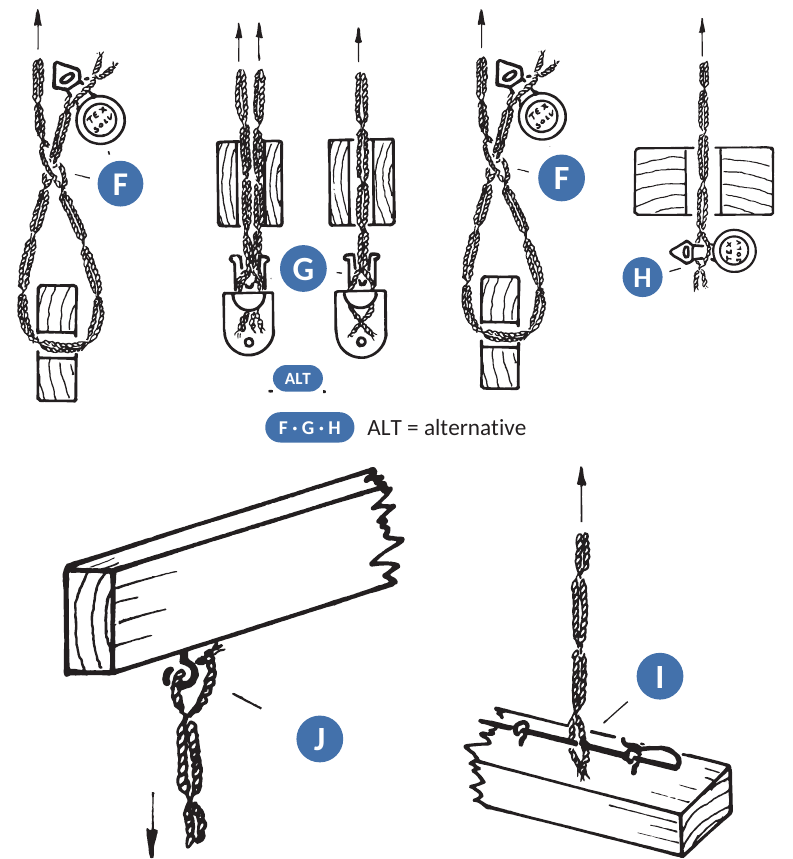
Measure the distance between the loom parts to be connected and add what the connection needs, usually a loop at each end. Try one cord before cutting many. For converting a loom or topping up there is a completion set with 50 m of 1/12 cord and straight and anchor pegs.
If you would rather not measure and cut, there are ready-cut tie-up sets with pegs for Glimåkra, Gunnar Andersson, Toika, Varpapuu and Curiosa looms, in counterbalance, countermarch and table-loom versions.
How do I cut and fuse it?
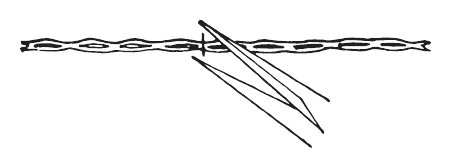
Cut between loops, never through them. Pass the cut ends quickly through a flame (candle, lighter or gas burner) so they fuse and cannot fray, or cut and fuse in one go with a small soldering iron. Do it in an open space, never under the loom. A template board with a nail gives every cord in a set exactly the same length.
Cutting cords to lengthStraight peg or anchor peg?
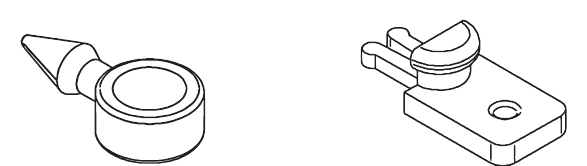
A straight peg goes through two loops and joins cord to cord. It is the peg you move when you adjust a tie-up. An anchor peg has a head and goes through a loop into a hole drilled in the loom, so the cord hangs from the wood itself. It fits a 5.5 mm (7/32") hole; for slightly larger holes there is a nylon bushing. Both lock by friction and move in seconds.
Can I wash it?
Yes, in lukewarm water with a mild detergent, preferably in a laundry bag so it does not tangle. Let it dry at room temperature; do not iron or tumble-dry. The polyester does not rot, is colourfast and stretches very little.
The three cords, tie-up sets, and every connection from the hints booklet.